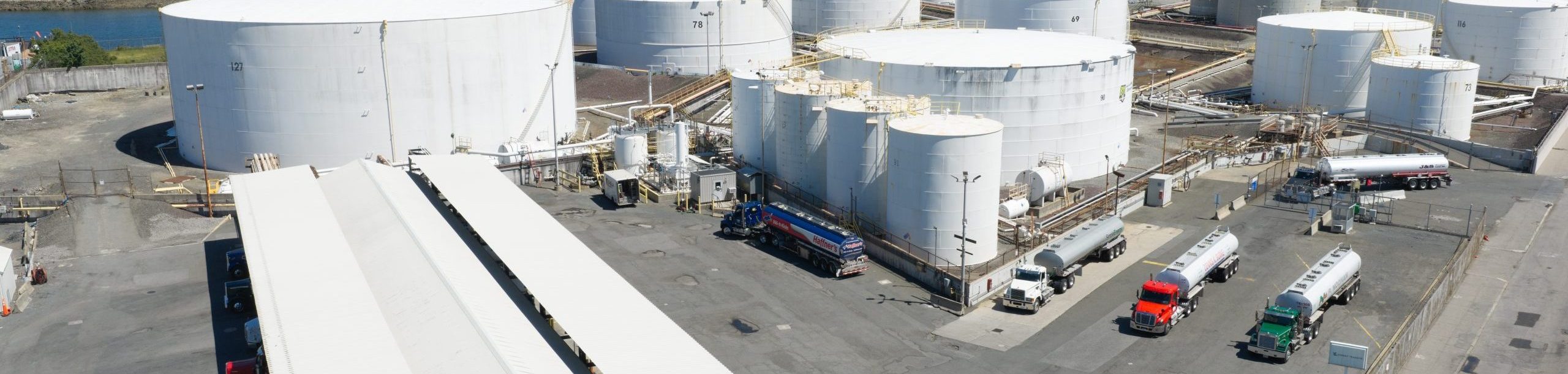
Energy Transfer’s East Boston Terminal
About
In the Northeast United States, we operate more than 8,200 miles of pipeline infrastructure and various types of energy infrastructure and facilities, including terminals and gathering systems.
Fueling the Region’s Future
Located on Chelsea Creek, Energy Transfer’s East Boston Terminal is a 24/7 bulk petroleum storage and distribution facility that serves as a critical energy hub for the region. Operating as one of the three remaining terminals on the creek, the facility receives, stores and distributes gasoline, diesel and jet fuel via marine vessel deliveries, pipeline, and a seven-bay truck loading rack. The terminal currently maintains a total storage capacity of over 1 million barrels across 21 above-ground tanks—specifically holding 437,520 barrels of jet fuel, 407,880 barrels of gasoline and 122,821 barrels of diesel, with room for expansion.
The terminal is uniquely positioned to serve Boston Logan International Airport. Boasting an unrivaled pipeline connection, it is the sole supplier of jet fuel to the airport, safely delivering the 39,000 barrels (1,638,000 gallons) of fuel required daily to keep flights in the air. The facility, which is staffed by 11 full-time employees from the surrounding region, also supplies regional airports and local gas stations via truck delivery.

Demand for jet fuel at Boston Logan International Airport continues to grow as passenger travel and flight activity increase. The Boston Logan Fuel Consortium (BOSFuel) projects jet fuel demand will rise by approximately 12% over the next five years. Today, Logan Airport consumes about 39,000 barrels, or 1.64 million gallons, of Jet-A fuel each day, all of which is supplied through the Energy Transfer East Boston Terminal. BOSFuel fuels approximately 540 aircraft daily, delivering Jet-A to an aircraft every two to three minutes to keep one of New England’s busiest airports operating safely, efficiently, and on schedule.
Project Overview
Enhancing Infrastructure to Meet Growing Demand

Reducing overall ship traffic along Chelsea Creek

Optimizing gasoline loading and minimizing truck idling times

Providing an environmentally responsible approach to gasoline blending, resulting in a cleaner, more reliable-burning fuel supply during the winter months

Sole supplier Boston’s Logan Airport’s jet fuel needs.
Energy Transfer Terminal Upgrades Proposed:
- New jet fuel storage tank (~46,000 bbl.)
- New jet filtration system with a higher capacity flow rate
- New variable frequency controls for pumps to optimize efficiency
- Replacement of an existing vapor recovery unit
- New gasoline storage tank (~225,000 bbl.)
- Installation of six additional loading arms at the truck rack
- Installation of an automated butane-blending system, including:
- Installation of two butane storage tanks (~1,425 bbl. each)
- Installation of a second butane truck offloading position

Benefits to the Community and Environment:

Reduced ship traffic along Chelsea Creek

Minimization of truck idling times

Cleaner and more reliable-burning fuel supply during the winter months

Reduction of 23.2 tons (57%) of VOCs
Quick Facts
Terminal Quick Facts:
- Sole provider of jet fuel to Logan International Airport
- Direct pipeline connection to the airport
- Currently on site are bulk storage tank facilities for jet fuel, gas and diesel
- Tank storage capacity is currently over 800 million barrels
- (Jet fuel: 437,520 barrels; Gasoline 407,880 barrels; Diesel (ULSD) 122.821 barrels).
- Dock offloading capacity for product delivery from ship or barge via the Chelsea River
- Truck loading capacity, including 7 loading bays
- 24/7 operation
Jet Fuel Demand Quick Facts:
- BOSFuel is projecting to see a 12% increase in jet fuel usage over the next five years, due to increasing flights.
- Logan Airport requires 39,000 barrels (1,638,000 gallons) of jet fuel daily – all supplied from the Energy Transfer East Boston Terminal.
- BosFuel delivers Jet-A to an aircraft every 2-3 minutes per day.
- BosFuel fuels 540 planes a day at Logan Airport.
Sign up to receive updates from Energy Transfer Northeast. From news to blogs and upcoming events, stay in the loop on important information.
Address: 467 Chelsea Street, East Boston, MA Contact: Nancy Sadlon, Public Affairs, Energy Transfer email: nancy.sadlon@energytransfer.com